Connector manufacturer
Connector manufacturer
How Cars Communicate: The Central Role of Telematics and Automotive Data Connectors
The automobile is undergoing its most profound transformation since the Model T first rolled off the assembly line. Today’s vehicles are no longer merely mechanical devices; they have evolved into sophisticated, data-generating platforms on wheels. At the heart of this transformation lies a complex communication ecosystem, enabling vehicles to exchange data with external networks, other vehicles, infrastructure, and our digital lives. This capability, largely driven by telematics and enabled by specialized automotive data connectors, is reshaping everything from vehicle maintenance and safety to user experience and business models. This article explores the technical architecture that makes modern vehicle communication possible, focusing on the central role of telematics control units and the physical and logical connectors that serve as the nervous system of the connected car.
The Telematics Control Unit (TCU): The Brain of Vehicle Connectivity
Definition and Core Functions
The Telematics Control Unit (TCU) is the embedded system that serves as the gateway for all external vehicle communications. Typically integrating cellular modems (4G LTE/5G), GNSS (Global Navigation Satellite System) receivers, and sometimes dedicated short-range communication (DSRC/C-V2X) modules, the TCU is the vehicle’s primary interface with the outside world. Its core functions are multifaceted:
- Data Aggregation and Mediation: The TCU collects data from the vehicle’s internal network—primarily the Controller Area Network (CAN bus)—which carries information from dozens of electronic control units (ECUs) managing the engine, transmission, brakes, climate, and infotainment. The TCU filters, processes, and often encrypts this data before transmission.
- External Communication: It establishes and maintains cellular connections to remote servers (OEM backends, third-party services), enabling functions like emergency calls (eCall), remote diagnostics, and over-the-air (OTA) updates.
- Local Connectivity Hub: Modern TCUs often integrate Wi-Fi and Bluetooth modules, creating in-vehicle hotspots and enabling seamless pairing with smartphones for projection standards like Apple CarPlay and Android Auto.
Architectural Integration
The TCU is not an isolated component. It is deeply integrated into the vehicle’s electrical/electronic (E/E) architecture. It connects to:
- CAN Bus Networks: For accessing vehicle operational data.
- Central Gateways: In more advanced, domain-oriented architectures, the TCU communicates with a central gateway that manages inter-domain data flow for security and efficiency.
- Infotainment Head Unit: For delivering connected services (navigation with real-time traffic, streaming media) to the driver display.
- Direct Sensors: In some designs, it may connect directly to auxiliary inputs like microphones for voice-assisted eCall or accelerometers for crash detection.
This position makes the TCU both a critical enabler and a prime target for cybersecurity, necessitating robust hardware security modules (HSMs) and stringent software protections.
Automotive Data Connectors: The Physical and Logical Nervous System
While the TCU processes and transmits data, a suite of specialized connectors forms the physical and logical pathways for data to flow into, within, and out of the vehicle. These can be categorized into internal vehicle network connectors, external diagnostic/access ports, and antenna systems.
- Internal Vehicle Network Connectors: The CAN Bus and Beyond
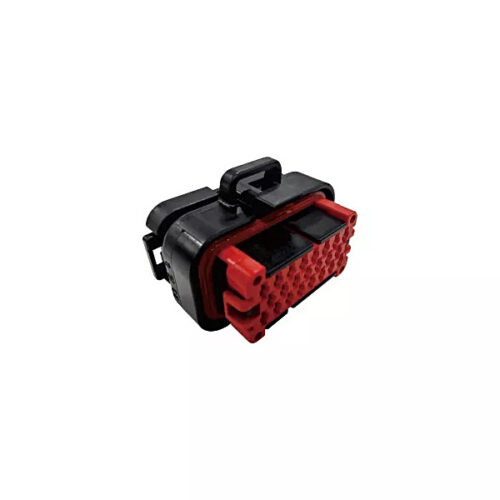
The Controller Area Network (CAN bus) is the historical backbone of vehicle communication. It uses a simple, robust two-wire differential serial bus (CAN_H and CAN_L) to allow ECUs to broadcast messages. The physical layer typically uses specialized, ruggedized connectors, such as the Deutsch DT series or TE Connectivity’s AMPSEAL connectors, designed to withstand harsh automotive environments—vibration, temperature extremes, and chemical exposure.
However, as data demands have skyrocketed with advanced driver-assistance systems (ADAS) and autonomous driving features, CAN (max ~1 Mbps) is insufficient for high-bandwidth sensors (cameras, LiDAR, radar). This has led to the integration of high-speed networking protocols:
- Ethernet (100/1000BASE-T1): Automotive Ethernet, using single twisted-pair cables, provides high bandwidth (100 Mbps to 1 Gbps+) over lightweight cabling. It uses standardized RJ45-like connectors (e.g., TE Connectivity’s MATEnet) but designed for automotive vibration and mating cycles. Ethernet enables zonal architectures, where data from sensors in one area of the car are aggregated in a local “zonal” ECU before being routed via high-speed backbone.
- FlexRay: A deterministic protocol used for safety-critical systems like brake-by-wire or steer-by-wire, offering higher speed and reliability than CAN.
- LVDS (Low-Voltage Differential Signaling): Common for transmitting uncompressed video data from cameras to displays or processing units.
The evolution from a federated ECU architecture with simple CAN to a domain/zonal architecture with high-speed Ethernet backbones represents a fundamental shift, with data connectors playing a pivotal role in enabling this new topology.
- The On-Board Diagnostics (OBD-II) Port: The Universal Diagnostic Gateway
The OBD-II port is the most well-known automotive data connector. Mandated in many markets since the mid-1990s, its primary purpose was standardized emissions diagnostics. The 16-pin J1962 connector, typically located under the dashboard, provides direct, standardized access to the vehicle’s primary diagnostic CAN bus.
Its role has expanded far beyond servicing:
- Telematics Dongles: Insurance and fleet management companies use OBD-II dongles to read vehicle speed, RPM, braking, and mileage data, transmitting it via embedded cellular or Bluetooth modules.
- Aftermarket Devices: Performance trackers, remote starters, and health monitors plug directly into this port.
- Official Diagnostics: Dealerships and repair shops use specialized scan tools connected to the OBD-II port to read fault codes, perform calibrations, and flash software updates.
While incredibly useful, the OBD-II port’s direct connection to critical vehicle networks is a significant security vulnerability, necessitating advanced firewall and intrusion detection systems in modern architectures.
- Antenna Connectors: The Link to the Outside World
The TCU’s connectivity is only as good as its antenna system. Modern cars feature a “shark-fin” or roof-mounted module housing multiple antennas, connected via coaxial cables with specialized connectors like FAKRA (FAmilienKReis Automobil) and its high-speed successor, H-MTD (High-Speed Data Transmission).
- FAKRA Connectors: Color-coded, keyed connectors ensuring correct pairing for specific signals (e.g., blue for GNSS, green for cellular). They handle frequencies up to 6 GHz, suitable for 4G LTE and GNSS.
- H-MTD Connectors: Designed to support higher frequencies (up to 20 GHz) and data rates required for 5G, satellite communication, and high-precision GNSS. They are backward-compatible with FAKRA but feature enhanced shielding for superior signal integrity in a crowded RF environment.
This antenna system is critical for all wireless telematics functions, from basic cellular connectivity and navigation to emerging V2X communication.
The Data Journey: From Sensor to Cloud
To understand the synergy between telematics and connectors, consider a real-world example: Predictive Maintenance.
- Data Generation: An engine ECU monitors crankshaft position sensor data, detecting minute variations in rotation via the low-speed CAN bus.
- Internal Aggregation: This data is broadcast on the powertrain CAN. The TCU, listening on this network via its physical CAN connector, aggregates this data point with others (oil temperature, pressure, fuel trim).
- Processing & Packaging: Within the TCU, an application filters and packages this data into a compressed, encrypted message.
- External Transmission: The TCU’s cellular modem modulates this digital message onto a radio frequency signal. This signal travels through an internal coaxial cable, through an H-MTD connector, to the roof-mounted antenna, and out to the nearest cellular tower.
- Cloud Analytics: The data is routed to the OEM’s cloud platform, where machine learning algorithms compare it to known failure patterns.
- Action: The system dispatches a proactive alert to the driver’s connected app, suggesting a service visit, and can even pre-order the suspected faulty part at the nearest dealership.
This seamless flow is entirely dependent on the reliability of every physical connector and the intelligent processing of the telematics unit.
Cybersecurity: Securing the Communication Channels
This extensive connectivity dramatically expands the vehicle’s “attack surface.” The data connectors, particularly the OBD-II port and external telematics interface, are potential entry points.
- Hardware Security: Modern TCUs incorporate HSMs—dedicated crypto-processors that securely store keys and perform encryption/decryption, ensuring data integrity and authenticity.
- Network Segmentation: Central gateways act as firewalls, isolating critical drive-control networks (powertrain, brakes) from infotainment and telematics networks. Unauthorized access via the OBD-II or telematics unit is thus contained.
- Secure Boot and OTA Updates: TCUs use secure boot processes to ensure only signed, authentic software runs. Secure OTA update protocols, managed via the TCU’s cellular link, allow OEMs to patch vulnerabilities and update software throughout the vehicle’s life, closing security gaps as they are discovered.
The Future: Towards Seamless and Intelligent Mobility
The evolution of vehicle communication is accelerating:
- Vehicle-to-Everything (V2X): Next-generation TCUs will integrate direct C-V2X radios, allowing cars to communicate directly with each other (V2V), infrastructure like traffic lights (V2I), and vulnerable road users (V2P), enabling cooperative safety and traffic efficiency applications.
- Centralized Compute & Zonal Architecture: The trend is toward powerful central compute platforms running consolidated software. In this model, the TCU’s functionality may merge into a central computer, with high-speed Ethernet switches managing data flow from simplified zonal controllers. Connectors will need to support even higher data rates and power delivery.
- Standardization and APIs: As cars become true IoT devices, standardized data APIs (like the Society of Automotive Engineers’ Vehicle Signal Specification) will allow secure, consented access to vehicle data for third-party services, transforming the telematics platform into an open innovation hub.
Conclusion
The modern automobile’s ability to communicate is a technological symphony orchestrated by the telematics control unit and enabled by a sophisticated array of automotive data connectors. From the robust, simple CAN bus to the high-speed Automotive Ethernet and the specialized FAKRA/H-MTD antenna links, these physical components form the indispensable nervous system. The TCU acts as the brain, mediating, processing, and securely transmitting the vast streams of data that define the connected car experience. As vehicles evolve into autonomous, electric, and seamlessly integrated members of the smart city ecosystem, the reliability, security, and bandwidth of these communication foundations will only grow in importance. Understanding this interplay between telematics and connectors is key to grasping the present and future of automotive innovation.
For more about how cars communicate: the central role of telematics and automotive data connectors, you can pay a visit to Gvtong at https://www.gvtong.net/ for more info.